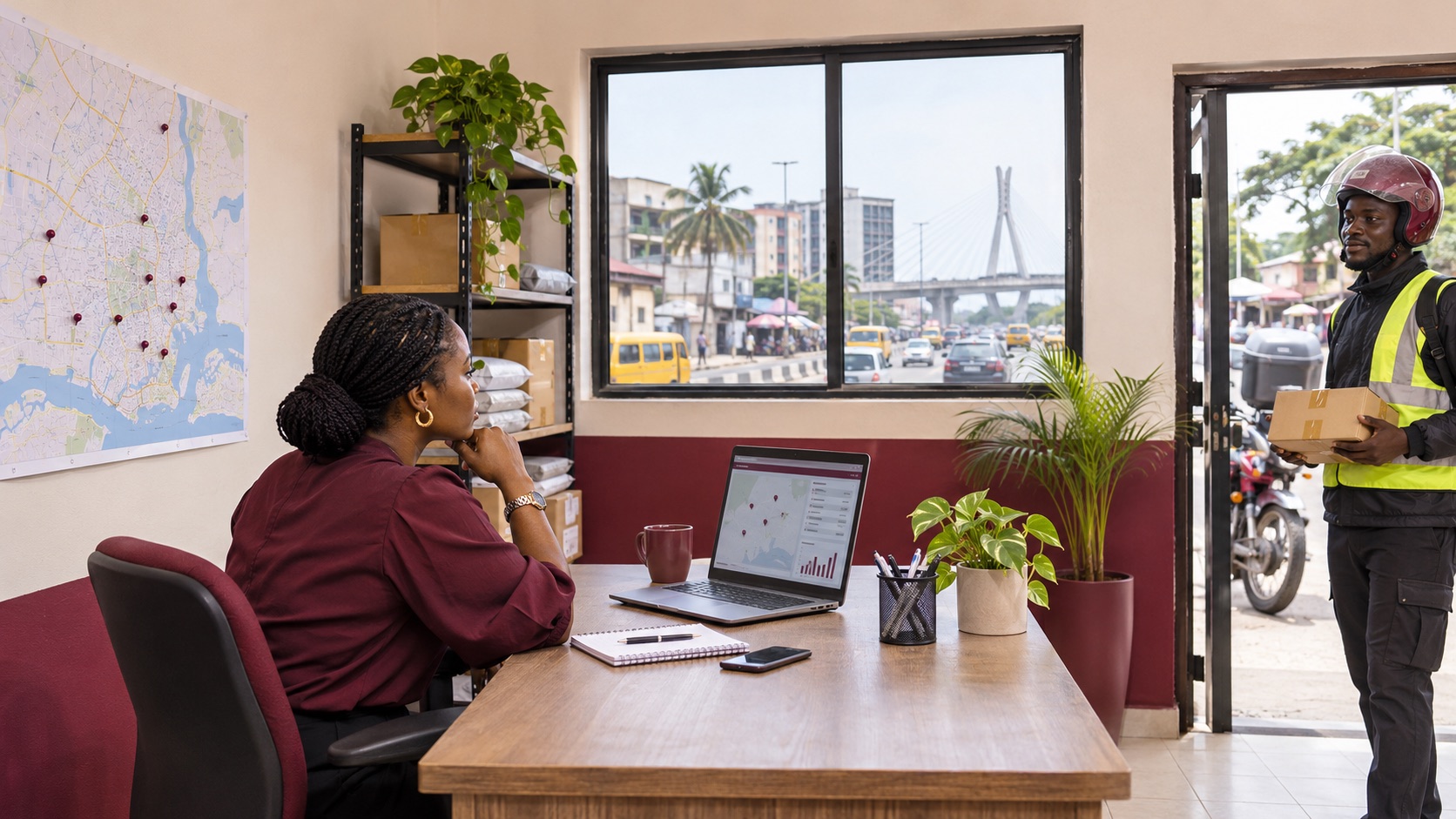
To start a delivery business in Nigeria, decide exactly whose parcels you will carry and where, confirm the licence that applies, then set up riders, dispatch, customer support, and a way to account for every order. Test a small, compliant service with paying customers before investing in a full app. If you live abroad, name the person in Nigeria who can resolve a late pickup or missing parcel while you are asleep.
This guide uses a small Lagos service as an example. The operating steps apply more widely, but vehicle and local requirements can differ by state and by what you transport. Check the current rules for your exact model before accepting paid deliveries.
First, are you delivering your own goods or other people’s parcels?
This is the decision that changes the plan. A restaurant delivering its own meals is different from a courier company charging many restaurants to deliver theirs.
The NIPOST Courier and Logistics Regulatory Department (CLRD) licence categories say its Special SME licence is for a business delivering to its own customers with no more than five motorbikes in the specified area. It does not authorise deliveries for third parties for a fee. CLRD lists separate regional, national, and international categories for courier operators according to their scope.
So if your idea is “we will deliver for local shops,” do not budget around the Special SME category without confirmation from CLRD. Ask the department which category covers your routes, customers, and operating structure. This question belongs in your financial plan before you buy bikes or quote merchants.
What must be ready before the first order?
Start with one customer type, one small service area, and a clear promise. For example, you might serve online sellers in one part of Lagos with scheduled parcel pickups. That is an illustrative model, not evidence that those sellers will buy from you.
Set up these six parts together:
- Registration and permission. Choose the business structure with Nigerian legal and tax advice where needed. CAC explains its online company registration and business-name registration. Registration alone does not grant a courier licence. Use CLRD’s application checklist to check the licence, business plan, office, insurance, and documents your model requires.
- Riders or a delivery partner. Decide whether you will employ or contract riders, or use an existing licensed operator. Verify identity, appropriate driving documents, vehicle registration, insurance, and the partner’s authority to carry the work. Agree who pays for fuel, maintenance, failed trips, and damaged goods.
- A dispatcher. Give one person responsibility for accepting an order, confirming its price and address, assigning a rider, and watching it through delivery or failure.
- Customer support. Publish a number customers can actually reach. Decide who answers late-delivery, loss, damage, refund, and return questions, including when the dispatcher is unavailable.
- A shipment and payment record. Give every order an ID. Record the customer, pickup and drop-off, quoted fee, assigned rider, status, proof of delivery, payment, and any complaint. Reconcile the order list with money received each day.
- A local decision-maker. If you are overseas, your operations lead needs written authority to replace a rider, approve a limited refund, or stop accepting orders when capacity is full. Our guide to choosing a local operator gives a fuller reporting checklist.
CLRD’s published application and operating requirements include goods-in-transit insurance, a daily shipment register, customer care, and a complaints procedure. They are useful operating disciplines as well as compliance items. For Lagos motorcycle operations, also verify current rider, vehicle, route, and insurance requirements with the relevant Lagos transport authorities; do not rely on a general article’s permit list.
What does one delivery actually involve?
Write the workflow before you draw app screens:
Request → quote → assignment → pickup → delivery or exception → payment reconciliation.
At request, confirm parcel type, pickup and drop-off addresses, contact numbers, service area, price, and promised time. At pickup, record who handed over the parcel and its condition. At delivery, capture an appropriate confirmation from the recipient and close the order. Limit access to customer addresses and phone numbers to the staff who need them.
The exception path matters just as much. What happens if the recipient is absent, the address is wrong, a rider breaks down, or a parcel arrives damaged? Set the contact, redelivery, return, and refund rules before a real customer is waiting. A delivery that never closes cleanly can consume more support time than several routine orders.
For an owner abroad, a daily report should show accepted, completed, failed, returned, and unpaid orders separately. Match rider payouts and customer payments to order IDs. A message saying “all done” does not tell you whether a parcel was delivered or whether the customer paid.
Can one delivery make money?
Calculate contribution per completed order: what the customer pays, minus costs that arise because that order happened. Those costs can include rider pay, fuel if you pay it separately, payment fees, packaging, support, expected redelivery, and expected refunds or loss. Do not count the same cost twice.
Here is a made-up calculation to show the method, not a Lagos price quote or forecast:
| Example item | Amount |
|---|---|
| Delivery fee received | ₦2,500 |
| Rider pay | −₦1,300 |
| Fuel paid separately | −₦350 |
| Payment, support, and expected failed-order costs | −₦250 |
| Contribution toward fixed costs | ₦600 |
That ₦600 is not profit. It still has to cover the dispatcher, insurance, licence and office costs, software, management, and taxes where applicable. If fixed monthly operating costs were hypothetically ₦300,000, you would need 500 such completed orders just to cover those fixed costs (₦300,000 ÷ ₦600). Failed orders, lower prices, or longer routes change the result.
Use quotes from your own riders, insurers, and suppliers, plus actual pilot orders, to replace every example figure. The official CLRD fee and service schedule is a better starting point for licence budgeting than an old blog estimate; confirm the category and current charge directly before paying. If the correct licence makes the model too expensive at your expected volume, change the model while it is still inexpensive to change.
How do you find the first merchants?
Choose merchants who have a repeated delivery problem in the area you can cover. Ask how they send parcels now, how many orders actually go out in a normal week, what happens on a failed delivery, and whether they pay per order or on account. Do not turn an expression of interest into a demand forecast.
Offer a narrow paid trial after your permissions, insurance, and operating process are in place. Give the merchant the service area, price, cutoff time, prohibited items, and support contact in writing. Record each completed order and ask the merchant whether they would send the next one. Our first-paying-customers guide explains how to track paid use rather than app installs.
Repeat orders tell you more than a launch-day spike. So do complaints: they show where your promise and your operation do not yet match. Use that evidence to adjust the route, staffing, and price before widening coverage.
When should you build a delivery app?
Use a shared order register and phone or WhatsApp communication to learn the workflow, provided your legal and operating requirements are already met. You can then specify software around the bottlenecks you have seen: merchant booking, dispatch assignment, rider status, proof of delivery, customer updates, payment records, and an owner view of exceptions and margins.
An app can reduce manual coordination and give a founder abroad clearer visibility. It cannot supply licensed riders, create merchant demand, or resolve a damaged parcel by itself. The right build decision comes from paid orders, repeat use, reliable fulfilment, and workable contribution per order. If you still need to test the customer problem, start with our guide to validating a Nigerian business idea from abroad.
How Venbrino can help
Venbrino builds branded apps and an owner dashboard for founders who need to see and manage a service with a team in Nigeria. For a delivery concept, a discovery call can turn your real dispatch workflow into a practical first app scope: what merchants submit, what riders update, what customers see, and which exceptions the owner must review.
Bring your chosen service area, customer type, licence guidance, order workflow, and any trial data to book a discovery call. We can plan the product around those facts while your local operation handles the deliveries.
Common questions
Do I need to buy motorcycles to start a delivery business?
Not necessarily. You can explore a contract with an existing licensed delivery operator. Check its actual coverage, rider and vehicle documents, insurance, service levels, and who handles complaints. Price the arrangement against your own-fleet option before choosing.
Is CAC registration enough to run a courier service?
No. CAC registers the business. NIPOST CLRD separately regulates courier and logistics operators. Confirm the correct licence and any state vehicle or rider requirements for your exact operation.
Can I run the service from the UK or another country?
You can own and oversee it from abroad, but deliveries need a capable local team and clear decisions on the ground. Use order-level records, payment reconciliation, and customer confirmations to see what happened. Your dashboard becomes more valuable once those records are reliable.
Should I build an app before I have paying merchants?
Usually, test the service and its economics first. An early app is useful when you can name the repeated coordination problem it will solve and the people who will use it. An app alone does not prove that merchants will pay or that deliveries will be completed.